


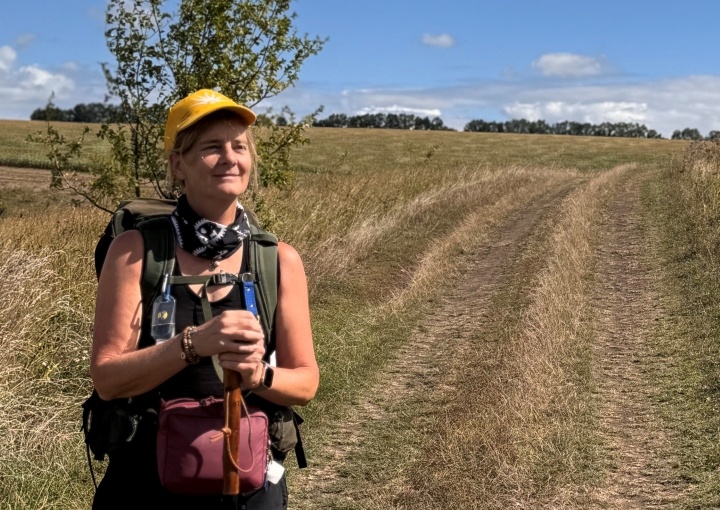
The Dutch pilgrim Margreet Botter (55) walked the Camino Podolico in twelve days in August and September 2026. With her pilgrimage, she raised money for the Veteran Mental Health Center of Excellence (VMHCE), an organisation in Kyiv that provides psychological support to veterans and their loved ones.
Margreet shared her experience of the trip and 9 discoveries along the way in a text for the Camino Podolico website (hereinafter – direct speech).
I walked the Camino Podolico alone. I don’t speak Ukrainian, and before I came here, I didn’t exactly have a lot of experience with air-raid alerts.
Before I left, people asked me all sorts of questions. Is it safe? Would I be able to communicate? Wasn’t I afraid to walk alone? To be fair, I had some of those questions myself.
Twelve days on the road gave me some answers. And quite a few I hadn’t been looking for. So, for anyone looking at the Camino Podolico from abroad and wondering, ‘Could I do this?’. Here are nine things I learned along the way.
1. You can walk the Camino Podolico alone
I’m used to walking alone, so that part didn’t worry me too much. What I did wonder was whether walking alone in Ukraine would feel different. Would I feel safe? Would I manage if something went wrong? And with so few pilgrims on the trail at this time of year, would twelve days on my own become very lonely?
It didn’t.
Yes, I walked alone for long stretches and sometimes for entire days, but somehow I never felt desperately lonely. Along the way, I met people. Sometimes I only passed them and said hello. Sometimes I walked with them for a while. And sometimes I was alone with the sunflowers and the trees. Thinking of home, friends and other pilgrims, I never felt completely alone.
So if you are hesitating because you don’t have anyone to walk the Camino Podolico with, you don’t necessarily need to find someone. You should be comfortable being on your own, because there may be many kilometres when you won’t see another pilgrim – or even another human being. But walking solo also makes it remarkably easy to connect with the people you meet along the way.
2. You don't need to speak Ukrainian
I had just visited the beautiful palace and waterfall of Maliivtsi. Now I was trying to find my accommodation for the night. It wasn’t where the coordinates on my map told me it would be.
Standing in front of the wrong house – with a small Dutch windmill in the garden! – and without a connection for my translation app, I must have looked a little helpless. The owners of the house wanted to help me, but we couldn’t understand each other. I showed them a photo of the place I was looking for, and the woman immediately set off in front of me to show me the way, while calling the owner at the same time. In the end, I arrived exactly where I needed to be, with a nice story to tell about the adventure of getting there.
Yes, not speaking the language can sometimes be difficult, but it is not a reason to stay at home. A good translation app is a great help. And accept that hands, feet, photos and a little patience and trust often work better than words.
3. Listen to your body and your backpack
After just one day of walking, I realised that my backpack was far too heavy to carry for all twelve days. I had to get rid of at least three kilos if I wanted to make it to the end.
It was one of the best decisions of the entire pilgrimage. I sent the things I didn’t really need to a contact in Kyiv and walked much lighter for the rest of the journey.
If you are coming from abroad, think beforehand about what you could do if you discover that you have brought too much. Have an address where you can send unnecessary stuff. It could be your home address, or perhaps somewhere in Vinnytsia where you started your journey. Arrange it in advance. Your shoulders will thank you.
4. This is a young Camino
If you have walked one of the well-established routes to Santiago de Compostela, the Camino Podolico may take some getting used to. This is not a trail where everyone you meet knows why you are carrying a backpack and where you are heading.
I discovered that one day when I was looking for a Camino stamp in a small village. I asked several people about the Camino Podolico, but nobody seemed to know what I was talking about. Eventually I realised why: they thought I was saying Kamianets-Podilskyi, the city where the Camino ends. I was telling them what I was walking; they thought I was telling them where I was going.
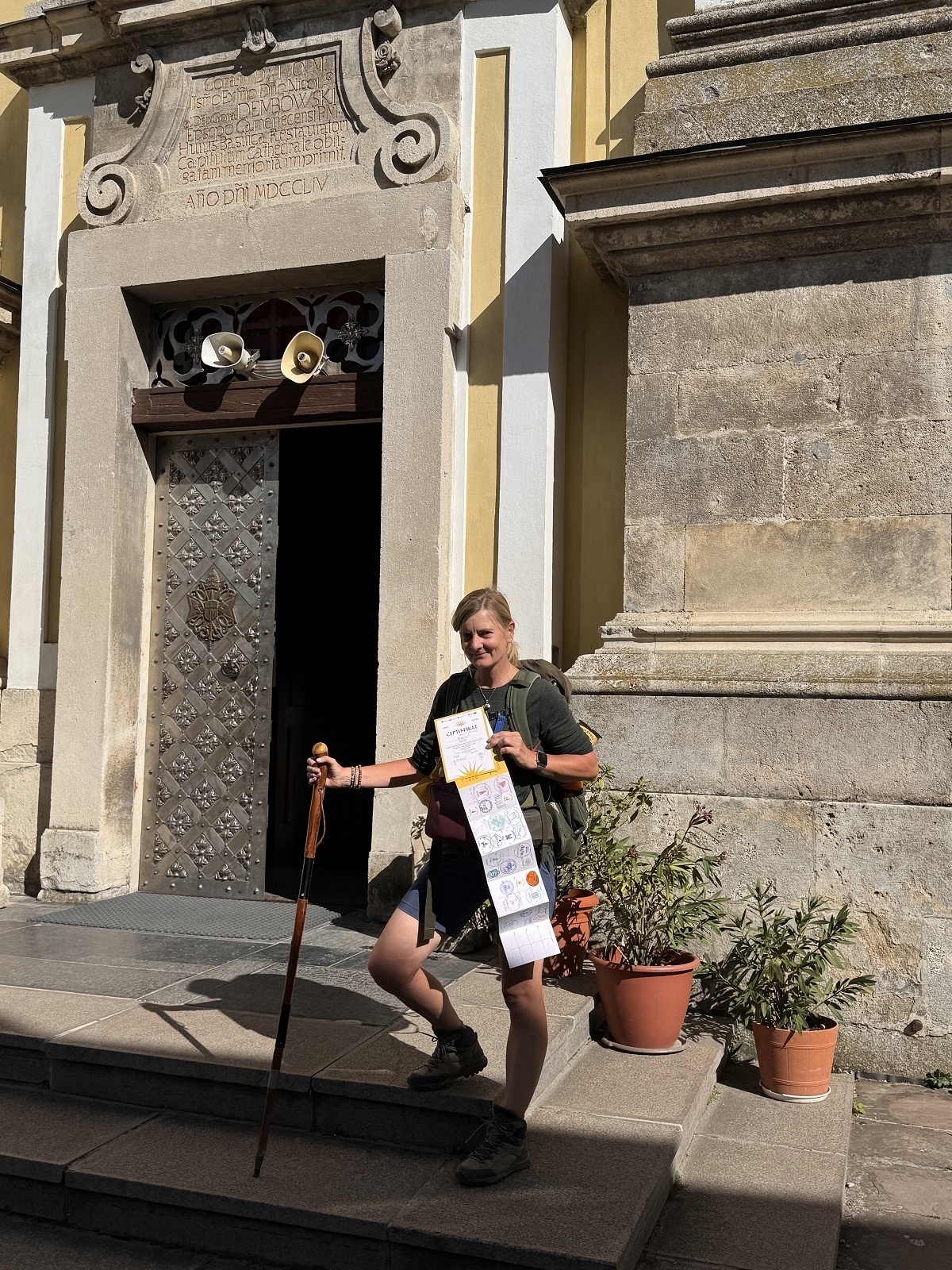
And then, not much later, I arrived at a place called House of Soul. Its owner immediately knew exactly what a pilgrim might need. Did I want to stay the night or just rest for a while? I could use the kitchen, make myself some coffee and eat my own lunch there. No, I didn't have to pay. And of course, there was a stamp for my pilgrim passport.
That contrast says a lot about this Camino. In some places, people don't know yet that a pilgrimage route passes through their village. In others, a small pilgrim culture is already beginning to grow. And because the Camino is still young, navigation sometimes requires a little extra attention too (I managed to take three wrong turns in my first five kilometres).
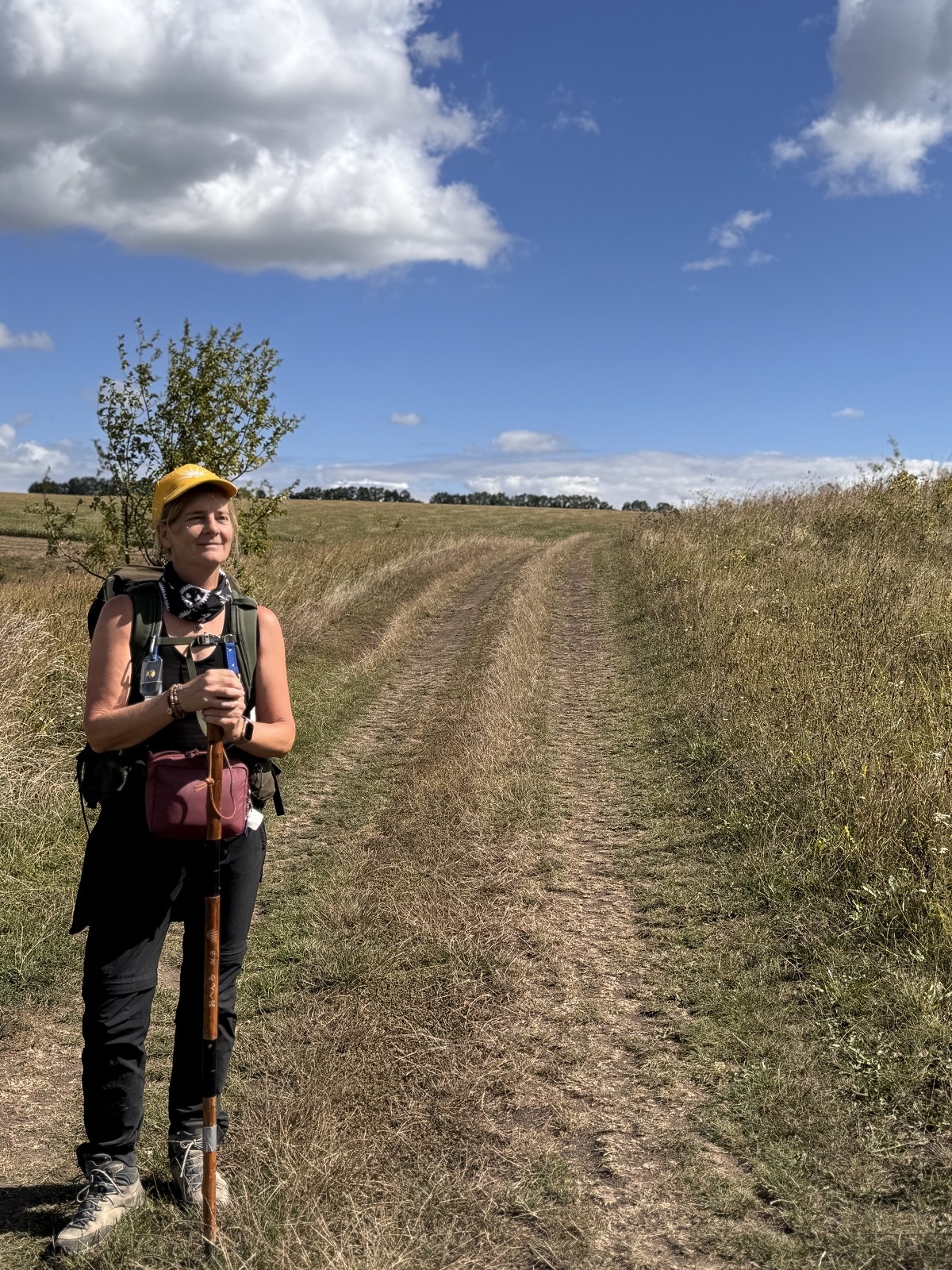
But that is also part of its charm. You are not walking through an area that has adapted itself to thousands of pilgrims. You are walking as a pilgrim through ordinary Ukrainian towns and villages.
So don't expect the Camino Francés. Make sure you have the route available offline, pay attention to where you are going and leave some room in your schedule for things not going quite as planned.
5. Don't expect a café around every corner
I learned this lesson on day one. After 28 kilometres, I arrived tired and hungry at my destination and discovered that finding somewhere to eat required more energy than I had left. (I have to say that I had only a littlebit energy left). The next morning I made sure I had some provisions in my backpack.
That became my routine. There are shops and cafés along the Camino, but not necessarily at the moment when you are hungry or thirsty. On one particularly hot day, I ran low on water. A man I met along the way filled my bottle with water from his well.
And then there was all the food I hadn't planned for: apples, pears and plums from trees, raspberries, tomatoes someone pressed into my hands, a piece of the famous Zinkiv sausage, and meals shared or offered along the way.
So check what you can expect before setting off in the morning and carry enough food and water to get yourself through the day. Anything else that comes your way is a bonus.
6. Hospitality doesn't need a common language
In Yaltushkiv, I was looking for a stamp for my pilgrim passport. The place where I expected to find it wasn’t there, but I found Oksana instead.
Communication wasn't easy. My Ukrainian was non-existent, her English wasn't much better, and even our phones weren't very helpful. But somehow none of that seemed to matter very much. Before I knew it, I was sitting at her table eating a bowl of borscht. She even offered me a place to sleep.
I remember watching her stir the soup in her Muhammad Ali T-shirt and thinking that I was falling a little bit in love with this region, this country and its people.
Some of the encounters I remember best from the Camino involved surprisingly few words. So don't worry too much about having the perfect sentence ready. Smile. Accept the coffee or the borscht. Get your phone out if you really need it. Sometimes that is more than enough.

7. Ukraine is more than the war but the war is there
Before coming to Ukraine, many people asked me about the war. Of course they did. But if the images on the news are your main frame of reference, they don't prepare you for what most of a walking day on the Camino Podolico actually looks like.
I walked through sunflower fields and sleepy villages. I sat beside lakes eating my lunch. I saw children playing, people doing their shopping, fishermen by the river and families enjoying their day. There were days when I walked for hours with nothing more dramatic happening than taking a wrong turn.
And yet the war was never completely absent. There were air-raid alerts. Memorials to fallen soldiers in towns and villages. Men in uniform. One day I passed a woman laying flowers along the road for her brother, a fallen soldier who was being brought home that day. That combination may be one of the things that stayed with me most: ordinary life and war do not take turns here. They exist alongside each other.
As a foreign pilgrim, be prepared for both. Know what to do when an air-raid alert sounds and take the reality of the war seriously. But also allow yourself to see everything else that Ukraine is. The Camino Podolico gave me plenty of that.
8. Being a foreign pilgrim changes the journey
On one of my walking days, two women on bicycles stopped when they saw me. They were ridiculously excited. I was the first pilgrim they had seen. That happened in different ways throughout my journey. People wanted to know where I came from, where I was walking and why. Sometimes that resulted in a short conversation. Sometimes in food, coffee or help. And sometimes it completely ruined my carefully planned walking schedule.
In Dunaivtsi, for example, all I wanted was a stamp for my pilgrim passport. Instead, I ended up drinking coffee with a woman from the local tourist office, being taken to a pottery workshop and leaving town an hour and a half later than planned, with five kilometres already on my feet before I had even properly started the day's stage.
On a Camino with thousands of walkers, you can disappear into the stream of pilgrims. Here, for now, you may be noticed.
And I discovered that this works both ways. I came to Ukraine because I wanted to walk its Camino. But several times, people's reactions made me realise that the simple fact that a foreigner had come to walk here meant something to them too.
So perhaps my last piece of advice is this: leave some space in your plans. The kilometres are only part of the Camino Podolico. Quite often, the things that slow you down are the things you will remember.
9. Feel connected to the others who walk or cycle this path
There weren't many pilgrims on the Camino Podolico, but the ones I met became part of my journey. I walked a full day with sisters Valeria and Victoria from Odesa. We hardly needed to talk; we simply fell into the same rhythm and walked. Paulina, a pilgrim travelling by bicycle, kept appearing and disappearing along the route, once passing me an energy bar before cycling off again. And on my final day, I met a Ukrainian pilgrim who was also a soldier. We walked the last kilometres to Kamianets-Podilskyi together.
That is perhaps another consequence of walking a young and quiet Camino: you may not meet many fellow pilgrims, but when you do, you notice each other. You walk together for an hour, a day or just a few kilometres, and then your paths separate again but you’ll always remember eachother.